
You did your part. Month after month, with discipline, you set aside a portion of your money in a savings account. That is an excellent habit and the first step toward a more secure financial future. Congratulations!
But what if I told you that by leaving your money in a savings account, you may actually be losing purchasing power?
It sounds strange, but it is the reality for many people. A savings account was the entry point to the financial world for generations, but today it no longer fulfills its primary role: protecting our money. This guide was made for you — someone who already saves and is ready for the next step, making your money truly work in your favor.
The Truth About Savings Accounts: Why They Are Not a Good Investment
The great villain of savings accounts has a name: inflation.
Simply put, inflation is the general increase in prices. That is why the $100 that used to fill a shopping cart a few years ago buys noticeably less today. When your investment's return is lower than inflation, your money loses value — even if the number in your account keeps rising.
Let's look at a practical example:
Imagine that at the start of the year you put $1,000 into a savings account. During the year, inflation ran at 7%, while the savings account earned 6%.
- On paper, you ended the year with $1,060. It looks like you gained $60, right?
- In practice, the cost of living rose 7%. To maintain your purchasing power, you would have needed $1,070.
Result: you have more money, but you can buy fewer things. You lost purchasing power. The savings account was not enough to protect your wealth. This is why we need a better benchmark.

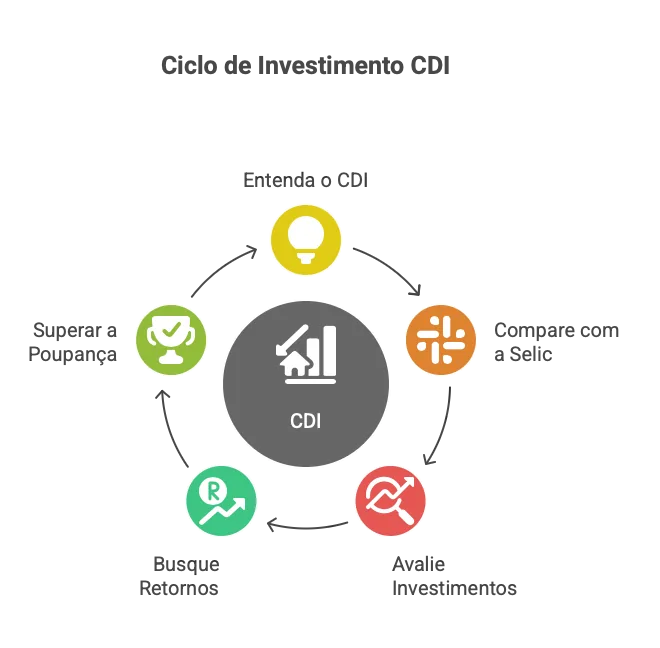
What Is a Benchmark Rate and Why Should You Use It?
You will hear this term often: benchmark rate. Do not be intimidated. Understanding it is simpler than it seems and will change the way you look at investments.
Think of the benchmark rate as the "interest rate between banks." Daily, banks lend money to each other, and the average rate of those loans becomes the reference rate. It tracks closely with the country's base interest rate.
“A good low-risk investment needs to, at minimum, match the benchmark rate. That is your new financial compass.”
Why does it matter? The benchmark rate has become the main thermometer for fixed-income investments. It is the "break-even point." Your new simple mission is: seek safe investments that return, at minimum, 100% of the benchmark rate. By doing so, you will already be, in most cases, significantly outpacing savings accounts.
Option 1: Treasury Inflation-Protected Securities (TIPS)
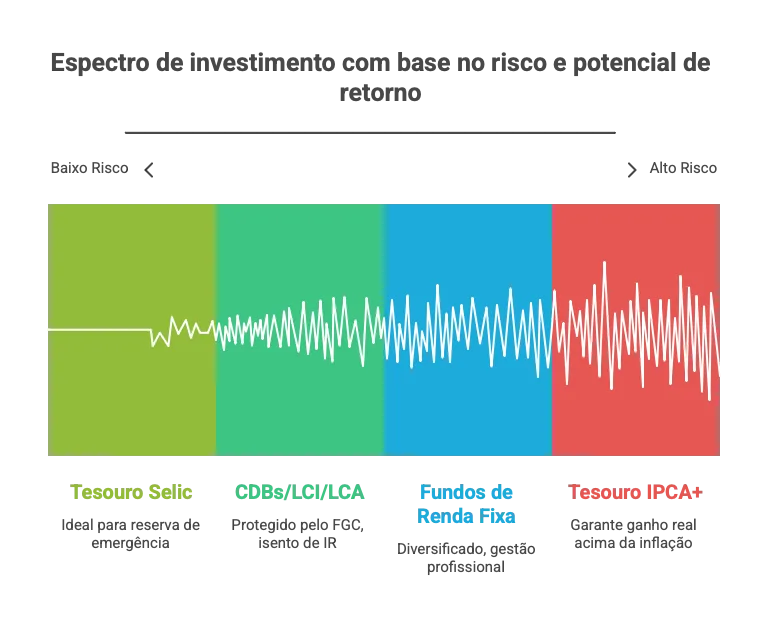
For those who have already built an emergency fund, short-term Treasury bills are old acquaintances. But Treasury programs offer other excellent options for medium- and long-term goals. The star here is the inflation-protected Treasury security — in the United States, this is known as TIPS (Treasury Inflation-Protected Securities).
The principle is straightforward: these securities pay you the official inflation rate plus a fixed real interest rate.
This means that, as long as they are held to maturity, your money's purchasing power is protected against inflation. For this reason, inflation-linked government bonds are popular for long-term goals where you cannot risk losing to inflation, such as:
- Retirement;
- Buying real estate in the future;
- Paying for your children's college education.
Option 2: Certificates of Deposit (CDs)
These are another popular and simple instrument for beginner investors.
When you invest in a CD, you are essentially lending money to a bank for a fixed period in exchange for interest. CDs typically offer better yields than standard savings accounts, with the trade-off being reduced liquidity — early withdrawals usually incur penalties.
The great advantage of CDs is security. In the United States, deposits are protected by the FDIC (Federal Deposit Insurance Corporation) up to $250,000 per depositor per insured bank. Similar deposit insurance schemes exist in most developed markets.
Always compare options and seek CDs that pay above the benchmark rate, and be aware of tax implications, as some instruments may offer tax advantages worth considering.
Option 3: Simple Fixed-Income Funds
Think of an investment fund as a "condo," where multiple investors pool their resources so a professional manager invests on their behalf.
A fixed-income fund will apply the money in a diversified basket of assets, such as Treasury securities, CDs, and equivalent instruments.
Who is it ideal for? For those who want to diversify their money simply, but do not have the time or knowledge to select each security individually. It is a way of outsourcing the management of your money to a specialist.
The one thing to watch out for is the management fee, a small percentage charged by the manager. Always check this fee before investing.
Checklist to Take the First Step
Ready to act? Follow this universal roadmap:
- Choose a brokerage or investment bank: Research solid, regulated institutions that offer low or zero fees for the investments you want.
- Open your account: The process today is almost always online, free, and fast. You will fill in your details and answer a questionnaire to define your investor profile (conservative, moderate, etc.). Be honest — this protects you.
- Transfer your money: Send the money from your current account to the brokerage account. It is simple and secure.
- Make your first investment: With money in the account, navigate the platform to the "Invest" or "Fixed Income" section. Choose one of the products we mentioned, set the amount, and confirm the application.

Conclusion: The Power Is in Your Hands
The savings account was an important step in your journey, but it should not be the final destination. Keeping your money there is like leaving a talented athlete on the bench: they are safe, but not using their full potential.
By understanding what inflation is, using the benchmark rate as your compass, and knowing safe alternatives such as TIPS, CDs, and fixed-income funds, you gain the power to truly grow your money.
You already have the knowledge. The next step — action — depends only on you. Start today.